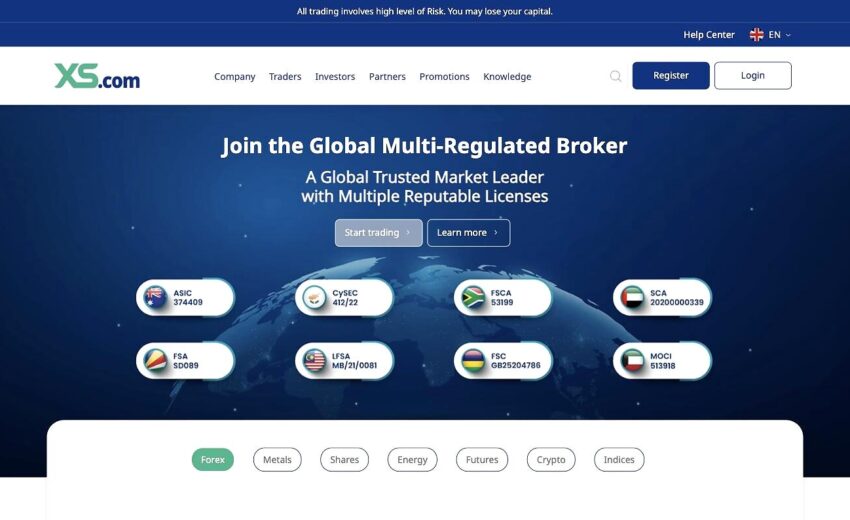
Verdict up front: XS.com (operated by the XS group of companies) is a genuine, established, multi-regulated forex and CFD broker — not a scam or a fake platform. Its domain has existed since 1992, and it holds real licences with regulators including Australia’s ASIC, Cyprus’s CySEC and South Africa’s FSCA. But “is XS safe?” has a more precise answer than a simple yes or no: your protection depends entirely on which XS entity your account is opened under — and many international retail clients are onboarded through offshore entities with far weaker safeguards. Here is what to check before you deposit, and what the withdrawal complaints are actually about.
Verified evidence (checked 25 August 2026)
- Domain age: xs.com was registered on 25 September 1992 (Verisign RDAP), through GoDaddy, is locked against transfer and change, and is paid through 2029 — a premium two-letter domain with a 30-plus-year history. This is the opposite of the brand-new throwaway domains typical of scam brokers. Anyone can re-run this at an RDAP lookup service.
- Regulatory status (each verifiable on the regulator’s public register): XS holds genuine onshore/EU licences — ASIC (Australia), XS Prime Ltd, AFSL 374409; CySEC (Cyprus, EU), XS Markets Ltd, licence 412/22; FSCA (South Africa), XS ZA (Pty) Ltd, FSP 53199; and SCA (UAE). Alongside these it operates offshore entities — FSA Seychelles (XS Ltd, SD089), Labuan (Malaysia), FSC Mauritius, and St Vincent / St Lucia — under which many international retail clients are actually onboarded, with much weaker protection.
- Sources: Verisign RDAP (xs.com); XS regulations page (xs.com/en/company/regulations); ASIC, CySEC and FSCA public registers.
What is XS.com?
XS is a multi-entity forex and CFD brokerage offering trading in forex, indices, commodities, shares and crypto CFDs. It operates internationally through a group of separately regulated companies (see the evidence above), using the premium xs.com domain that has been active since 1992. On the basic tests of legitimacy — a long-established domain, real regulatory licences you can look up, and a transparent corporate structure — XS is a real broker, not a clone or a fly-by-night operation.
ATTENTION READ THIS 👉
Bibox Exchange Alert: Withdrawal Complaints, Regulatory Gaps
Is XS.com regulated and safe?
Yes, genuinely — but the licence that matters is the one your account actually sits under, and they are not equal:
- Onshore / EU entities (stronger protection): if you are onboarded under the ASIC (Australia), CySEC (EU) or FSCA (South Africa) entity, you get that jurisdiction’s protections — segregated client funds, leverage limits, a formal complaints/dispute process, and in the EU and Australia access to compensation arrangements.
- Offshore entities (weaker protection): if you are onboarded under the Seychelles (SD089), Mauritius, Labuan or St Vincent entity — common for international retail clients — you typically get higher leverage but much weaker safeguards: limited recourse if something goes wrong, and generally no investor-compensation scheme.
What to do: before depositing, check the client agreement and the small print in the footer of the exact page you sign up on to see which entity and regulator you are contracting with, then verify that licence number directly on the regulator’s own public register. If you have a choice, pick the onshore/EU-regulated entity.
The withdrawal question
Many people specifically search for “XS.com withdrawal”, so it is worth being precise. XS is not the subject of any regulator scam warning, and withdrawal complaints against large multi-regulated brokers are common and usually procedural rather than evidence of fraud. The usual causes are:
- Identity verification (KYC) not yet completed;
- Trying to withdraw to a different method than you deposited from (most brokers require the original funding source);
- Bonus or credit terms that lock funds until trading-volume conditions are met;
- Pending or open positions.
If a withdrawal is delayed: complete your identity verification, withdraw to the original funding source, re-read any bonus terms, and escalate in writing. Crucially, if your account is under the ASIC, CySEC or FSCA entity you have a real dispute path (the regulator or its ombudsman); under an offshore entity you largely do not — another reason the entity you choose matters.
IMPORTANT UPDATE 👉
Go Future ProMarket Review: Unregulated Broker, Fund-Safety Warning
The real risks to understand
- CFDs are high-risk. They are complex, leveraged products and the large majority of retail CFD accounts lose money. This applies no matter how well-regulated the broker is.
- Offshore-entity accounts carry weaker protection and higher leverage — easier to lose more, harder to seek recourse.
- Impersonation. Scammers clone well-known broker names. Only ever use xs.com, and verify any licence number on the regulator’s own website rather than trusting a logo on a landing page.
Already lost money to a broker or a broker impersonator?
If a platform is refusing or endlessly delaying your withdrawal, or you suspect you dealt with a clone impersonating a regulated broker, act quickly: stop further deposits, gather evidence (statements, transaction records, correspondence, the exact URL and entity you signed up with), and file a complaint with the relevant regulator. Our team also assesses recovery options — see Broker Verification and Financial Dispute Support, or contact us at support@ettran.com.
Bottom line
XS.com is a legitimate, established, multi-regulated broker — not a scam. The real question is not “is XS a scam?” but “which XS am I signing up with?” Choose the onshore or EU-regulated entity where you can, verify the licence number yourself on the regulator’s register, understand that CFDs are high-risk leveraged products, and keep records of everything. Used that way, XS is a real broker; the things to watch are the offshore fine print and CFD leverage — not fraud.
How we reviewed this: see our Review Methodology and Editorial Standards. Reviewed under the editorial oversight of David Sanders, Licensed Fraud Investigation Agent, Investor Protection Unit — Pinkerton.