
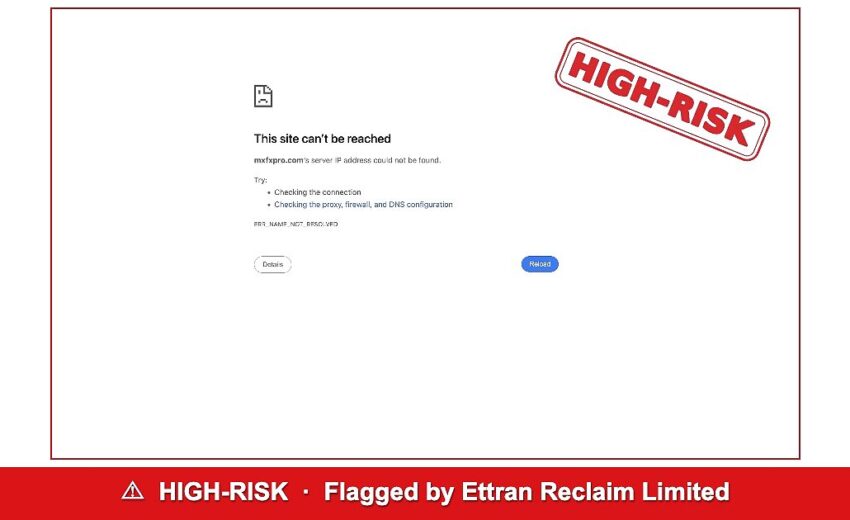
Verdict up front: MXFX (mxfxpro.com) has gone dark. Broker-watchdog BrokersView recorded the site offline on 16 August 2026 and noted user reports that the platform had absconded with funds. Our own registry check goes further: the domain is no longer registered at all. There is nothing left to trade with and nobody left to ask.
Verified evidence (checked 27 August 2026)
- Watchdog record: BrokersView recorded MXFX on 16 August 2026 as Unregulated, category Suspected Inactive / Website Offline, listing the site as http://www.mxfxpro.com/.
- What the watchdog said, verbatim: “BrokersView found that the domain ‘http://www.mxfxpro.com/’ is currently inaccessible. This is widely regarded as a significant red flag, as the suspension of a broker’s website often points to underlying regulatory or operational issues. Additionally, some users have reported that the platform may have already absconded with their funds.”
- The domain is now gone entirely: our check of Verisign’s authoritative registry records for .com returns no record for mxfxpro.com — the name is not merely parked or suspended, it has been dropped from the registry. A control query against a live domain on the same endpoint returned valid data, so this is a genuine not-found rather than a lookup failure.
- No DNS at all: the name does not resolve. There is no website, no mail server and no client portal.
- Regulation: none. There is no licence to check and no live entity for a regulator to supervise. Sources: BrokersView broker record (16 Aug 2026); Verisign registry lookup (27 Aug 2026); DNS resolution check.
| Related Investigation The disappearing-broker pattern, start to finish. |
Investors, Take Note A dropped domain usually means deposits were taken first. |
Read This Before You Invest Never send funds to a platform with no live presence. |
What was MXFX?
MXFX traded through mxfxpro.com as an online foreign-exchange platform. It held no verifiable licence from any regulator, and today it has no website, no registry record and no reachable point of contact. Between those two states lies a period in which people deposited money.
ALSO SEE THIS REPORT 👉
Vernier Capital Advisors Review: Regulation Concerns, Fund-Safety Warning
Broker-watchdog BrokersView catalogued the platform on 16 August 2026, filing it under “Suspected Inactive / Website Offline” and noting that some users had reported the operators making off with their funds. Eleven days later the domain itself had gone from the registry.
“Offline” and “deregistered” are not the same thing
The distinction matters, and it makes this case unusually final.
A domain can be offline for several reasons. Its registrar may have suspended it after abuse complaints — a status called clientHold, which pulls the name out of the DNS while leaving the registration intact. Hosting may have lapsed. The operator may simply have switched the site off. In each of those cases the registration still exists, and a registry lookup still returns the creation date, the registrar and the expiry.
MXFX is past that stage. A lookup against the authoritative .com registry returns nothing at all: no creation date, no registrar, no status. The registration has expired or been deleted and the name has fallen out of the system entirely. Whoever ran mxfxpro.com stopped paying for it and let it go.
INVESTORS, TAKE NOTE 👉
INNO Trade Review: Unregulated Broker, Regulation Concerns
Why that is the worst outcome for anyone owed money
When a regulated firm fails, there is an orderly process: a supervisor, an administrator, client-money segregation rules, and in many jurisdictions a compensation scheme. Records are preserved because someone is legally obliged to preserve them.
When an unlicensed platform lets its domain lapse, none of that applies. The website is gone, so any account balance shown there is gone with it. The email addresses at that domain no longer receive mail, so the support address, the compliance address and the “withdrawal department” are all unreachable. There is no registered entity to serve papers on, no supervisor with jurisdiction, and often no way to establish who was behind it. The only records that survive are the ones the customer kept.
The lifecycle this fits
Hit-and-run trading platforms follow a recognisable arc. A domain is registered cheaply. A template site goes up, offering leverage, bonuses and a professional-looking dashboard. Marketing runs hard for a few months through social media, messaging apps or cold calls. Deposits are collected and displayed as growing balances. Withdrawal requests begin to stall, then draw demands for fees or taxes. Complaints accumulate. The site goes offline. The domain lapses.
Each stage is cheap and each is disposable, which is why the same operators can repeat the cycle under a new name within weeks. It is also why the age of a domain is one of the most useful things a prospective client can check: the business model depends on the front end being new.
What is left to do
If your money went into MXFX, the platform itself offers no route to recover it — there is nothing there to answer you. What remains useful is everything outside the platform: your bank and card records, the payment references, any crypto transaction hashes, and the correspondence you kept. Those are what a bank, a regulator or a police fraud unit can actually work with.
Check it for yourself
Nothing above depends on trusting us. Search the name on Google, ask ChatGPT, and run the register checks named in the evidence box. A regulator warning takes about a minute to confirm on the regulator’s own website, and that minute is the cheapest due diligence available to any investor.
This one takes seconds to confirm. Try the address at mxfxpro.com and see that nothing loads. Then run the domain through any public registry lookup service and note that it returns no record whatsoever — not a suspended registration, but no registration at all.
If you have already deposited
Act on paper, not on hope. Save every screenshot, chat log, email, payment reference and wallet address before the platform can close your account — once access goes, so does your evidence. Report the loss to your national financial regulator and to your police force’s fraud unit. Tell your bank or card issuer immediately; where funds moved by card or transfer within recent weeks, a recall or chargeback is sometimes still possible. If you paid in cryptocurrency, the transaction cannot be reversed, but the receiving address is permanent evidence and exchanges can sometimes freeze onward movement.
Then brace for the second approach. Victims of investment fraud are frequently contacted again by people offering to recover the money for an upfront fee, sometimes posing as lawyers, regulators or the platform’s own compliance department. That is a second fraud aimed at the same victim. No legitimate recovery service, and no regulator anywhere, asks for a payment before returning your funds.
The bottom line
MXFX operated without a licence, was catalogued by a broker watchdog as offline amid reports of missing client funds, and has since let its domain lapse out of the registry altogether. That total disappearance is the characteristic end-state of a hit-and-run trading scam, and it is why the checks worth doing are the ones you do before you deposit.
Reviewed by David Sanders, Licensed Fraud Investigation Agent, Investor Protection Unit — Pinkerton. Corrections: support@ettran.com.