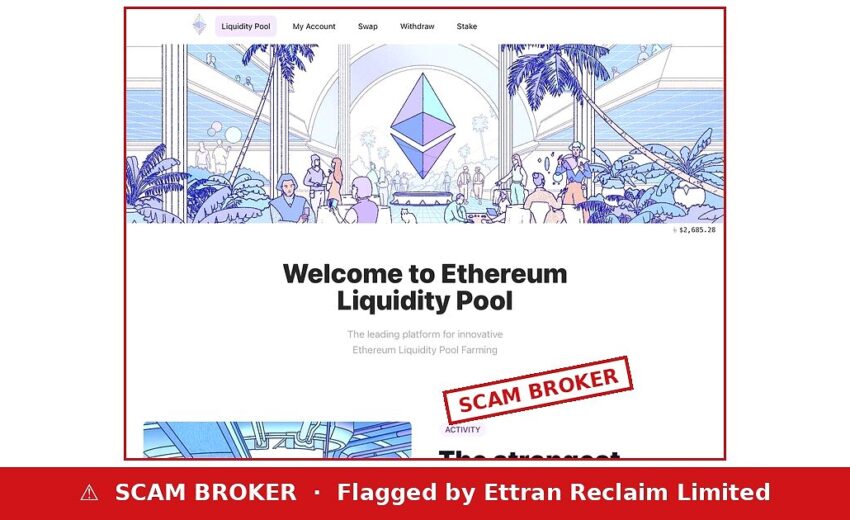
Verdict up front: Henuet (henuet.com) greets visitors with “Welcome to Ethereum Liquidity Pool” and promises daily ETH rewards from “liquidity pool farming”, plus a 30% referral reward. The Dutch AFM warned about it on 4 June 2026. The domain was registered on 17 March 2026 — about six months ago.
| Website | henuet.com |
|---|---|
| Product | “Ethereum Liquidity Pool Farming”, swap, stake, withdraw |
| Claims | 1,120 nodes; 11,779 participants; 95.91M “USDC Verified”; 1.62M ETH reward |
| Referral | “30% ETH reward every time your friends receive their reward” |
| Regulator | AFM (Netherlands) warning, 4 June 2026 |
| Domain registered | 17 March 2026 (Tucows) — about 6 months old |
Wearing Ethereum’s clothes
The page uses the Ethereum diamond logo and the headline “Welcome to Ethereum Liquidity Pool”. Ethereum is open-source software, not a company that pays pool rewards. Using its name and artwork makes a private website look like part of the network.
READ THIS BEFORE YOU INVEST 👉
ESPERIO Review: Regulation Concerns, Unregulated Broker
Dealing with Henuet right now?
✎ FILE A COMPLAINT ABOUT HENUET
Or write to support@ettran.com — Include what you paid Henuet and through which bank or wallet. We never need your login details.
How the reward is explained
“The cryptocurrency mined every day generates ETH revenue and gives us a certain percentage of revenue in accordance with contract standards.” Ethereum stopped being mined in 2022. The sentence explains nothing about where your reward would come from.
READ THIS BEFORE YOU INVEST 👉
Foti Markets Review: Unregulated Broker, Fund-Safety Warning
Numbers on a six-month-old site
Counters show 11,779 participants, 95.91M “USDC Verified” and 1.62M ETH paid. There is no contract address, no audit and no company. A balance widget shows “$2,683.12” before you have connected anything.
The wallet is the target
Sites in this pattern ask you to connect a wallet and ‘authorise’ USDT or USDC to join the pool. That authorisation can let the site move your tokens. The 30% referral reward then turns victims into recruiters.
⚠ Verified evidence
- The Dutch AFM warned about henuet.com on 4 June 2026.
- Uses Ethereum’s name and logo with no company named.
- Says rewards come from crypto “mined every day”.
- Pays a 30% referral reward; domain registered 17 March 2026.
If money has gone to Henuet
- Do not pay any “tax”, “unlock” or “verification” fee Henuet asks for — those charges never release a balance.
- Do not reply to new messages from Henuet staff; block the numbers.
- Tell family members who may also have been approached about Henuet.
- Card payment? Request a chargeback for “services not provided” as soon as possible.
Testing Henuet’s claims
The quickest test is the AFM register at afm.nl: search “Henuet” and, separately, henuet.com. Then compare the domain date (17 March 2026 (Tucows) about 6 months old) with the history the site claims. The AFM also keeps a public warnings list — the domain itself should appear if it has been flagged. If you are outside Dutch AFM’s country, check your own regulator as well.
The verdict: Henuet borrows Ethereum’s branding to sell a pool with no company, no contract and a recruiting bonus. The AFM has warned about it. Do not connect a wallet.
Stuck with Henuet?
✎ FILE A COMPLAINT ABOUT HENUET
Or write to support@ettran.com — Include what you paid Henuet and through which bank or wallet. We never need your login details.
Sources, checked 1 October 2026: AFM (Netherlands) warning via IOSCO I-SCAN (4 June 2026) · RDAP registration record for henuet.com · the live page at henuet.com, read in full. Warnings come from regulators, not courts. General information, not investment advice.
Rechecked on 17 November 2026
On 17 November 2026 henuet.com was still online.
How to check a warning from the AFM
The Dutch AFM publishes warnings about firms offering investment services without a licence and keeps a public register of licensed firms. Search the exact name and web address. A firm licensed elsewhere in the EU must be passported into the Netherlands and listed as such. Report the site to the AFM and your bank.
If you already paid
- Stop all further payments, including any “fee”, “tax” or “release charge”.
- Write down every wallet address you sent crypto to and the transaction hash for each transfer.
- If you bought the crypto through an exchange, report the transfers to that exchange’s support and fraud team.
- Report card and bank payments that funded the purchases to your bank as fraud.
- Report the site to the regulator named above and to the police.
- Be wary of anyone who contacts you offering to recover the funds for an upfront fee.