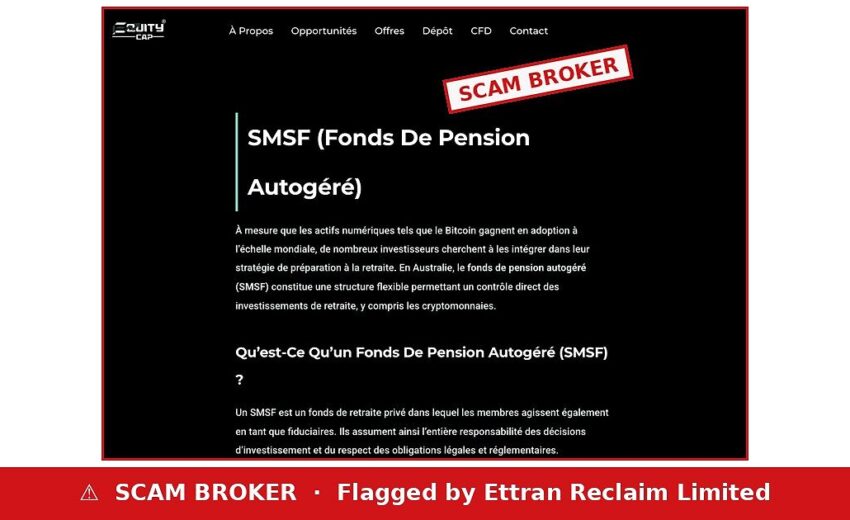
Verdict up front: Equity Cap (equity-cap.com) sells forex, crypto, ETF and index CFDs in French. It names no company, no address and no licence. France’s AMF blacklisted the site on 29 September 2026. Do not deposit.
| Website | equity-cap.com |
|---|---|
| Language | French |
| Domain registered | 24 November 2025 — about ten months old |
| Regulator | AMF (France) blacklist, 29 September 2026 (via IOSCO I-SCAN) |
| Registrar | NETIM SAS |
| Status | Live — page loads today |
A broker with no owner
The homepage promises forex “with precision and excellence”, crypto, ETFs and indices, and a sign-up at /account/register. Nowhere does it say which company runs it, where it is based or who licenses it. The footer says only “© 2026 Equity Cap”.
ALSO SEE THIS REPORT 👉
Moomoo.com Exposed: Warning ! User Complaints, and Why Investors Should Stay Alert
Australian retirement money, in French
A footer page titled “SMSF (Fonds de pension autogéré)” explains Australia’s self-managed super funds and how to put Bitcoin into retirement savings. A French-language CFD site has no reason to explain Australian pension rules — unless the same template is being used to chase retirement savings in more than one country.
Did Equity Cap call or message you?
✎ FILE A COMPLAINT ABOUT EQUITY CAP
Or write to support@ettran.com — include the website, what you paid and any screenshots. Do not share recovery words with anyone.
ALSO SEE THIS REPORT 👉
The Hidden Dangers of Arturoinvest.com
A template that was never finished
The site’s logo links to template-kit.evonicmedia.com/layout93 — the demo page of the commercial website template it was built from. Its FAQ answers its own question “Is Equity Cap safe?” with a single word: “Oui”.
Arbitrage as a selling point
Another footer page pitches crypto “arbitrage” — buying on one exchange and selling on another. It is a common hook on unlicensed platforms because it sounds risk-free. It is not.
⚠ Verified evidence
- France’s AMF blacklisted equity-cap.com on 29 September 2026 (IOSCO I-SCAN).
- No company name, address, licence or regulator anywhere on the site.
- A French page promoting Australian SMSF pension investment in Bitcoin.
- Domain registered 24 November 2025.
Look Equity Cap up before you pay
Go to the REGAFI register and the AMF’s black lists at amf-france.org. Enter equity-cap.com first, then the trading name “Equity Cap”. The AMF black list is searchable by domain, which catches mirror sites. A WHOIS or RDAP lookup on equity-cap.com shows the registration date: 24 November 2025. A match on name alone is not enough — the website on the entry must be equity-cap.com.
The verdict: Equity Cap has no named owner, no licence, an unfinished template and an Australian pension pitch on a French site. The AMF has blacklisted it. Do not deposit.
Stuck with Equity Cap?
✎ FILE A COMPLAINT ABOUT EQUITY CAP
Or write to support@ettran.com — include the website, what you paid and any screenshots. We never need your password.
Sources, checked 29 September 2026: AMF blacklist via IOSCO I-SCAN (29 September 2026) · RDAP registration record · equity-cap.com homepage, /smsf/ and /trading-darbitrage/
Rechecked on 17 November 2026
On 17 November 2026 equity-cap.com was still online, under the page title “Equity Cap – Trade Smarter, Faster & Secure!”. The domain equity-cap.com was registered on 24 November 2025. It is registered only until 24 November 2026.
How to check a warning from the AMF
The Autorité des marchés financiers publishes lists of websites and firms that offer investment services without authorisation. Search the site name and web address there, and check the official registers of authorised firms before opening any account. A firm that names no company, address or licence on its website cannot be checked at all, which is reason enough to stay away. Report the site to the AMF and your bank.
Sites like this are rarely found by chance. Most victims arrive through a social media advert, a message from someone they met online, or a call after filling in a form. If someone directed you to this platform, the messages they sent are evidence. Keep them, and do not let anyone install remote-access software on your phone or computer.
If you already paid
- Stop all further payments, including any “fee”, “tax” or “release charge”.
- Write down every wallet address you sent crypto to and the transaction hash for each transfer.
- If you bought the crypto through an exchange, report the transfers to that exchange’s support and fraud team.
- Report card and bank payments that funded the purchases to your bank as fraud.
- Report the site to the regulator named above and to the police.
- Be wary of anyone who contacts you offering to recover the funds for an upfront fee.