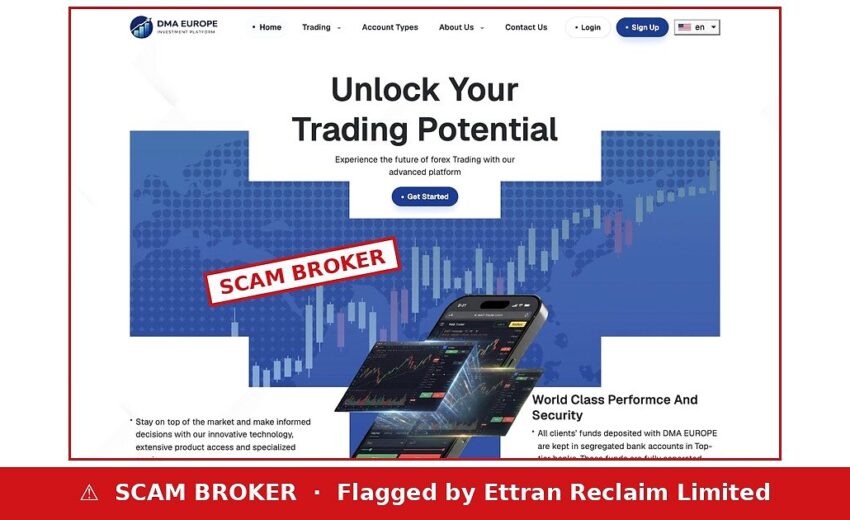
DMA Europe tells visitors it is “regulated by the Dutch authorities AFM and DNB, and registered with CONSOB under registration number 5536”. CONSOB is the Italian regulator that ordered internet providers to block access to this exact domain.
| Brand | DMA EUROPE — Investment Platform |
| Domain | dmaeu.com |
| Domain registered | 25 June 2026 — three months old |
| Stated address | Oude Enghweg 2, 1217 JC Hilversum, Netherlands |
| Regulators claimed | AFM, DNB and CONSOB registration 5536 |
| Regulator action | CONSOB blackout order — site listed on its register of abusive sites |
| Markets offered | Forex (70+ pairs), commodities, stocks, indices |
The number is the problem
Quoting a regulator is meant to end the argument. Here it starts one. A CONSOB registration number sits in the footer of a site that CONSOB has told Italian providers to make unreachable. Those two facts cannot both describe a firm in good standing, and only one of them was written by the regulator.
ATTENTION READ THIS 👉
KEDEXTRADINGFX Review: Regulation Concerns, Unregulated Broker
There is a second tell in the same sentence. The footer says “DMAsseteuBV is a brand operated by DMA Europe B.V.” Two different company strings in eleven words, on the one line where a broker is supposed to be precise about who it is.
Three months old, and already European
The domain was created on 25 June 2026. The site speaks of “the future of forex trading”, a “large, highly skilled trading services team” and clients whose money sits in “segregated bank accounts in Top-tier banks”.
No bank is named. Segregation is a claim that can be evidenced — the bank, the account structure, the auditor who checks it — and a firm that means it says so. A firm that does not name anything is describing a feeling, not an arrangement.
READ THIS BEFORE YOU INVEST 👉
Yield Mechew Innovate Review: Fund-Safety Warning, Unregulated Broker
Why an address is not a licence
A Hilversum street address is easy to rent and easy to print. What matters is whether the AFM register carries this firm, under this name, for this activity. Anyone can check a Dutch licence in minutes, and nobody should deposit before they have. The same goes for the CONSOB number, which is the claim most directly contradicted by CONSOB itself.
TALK TO ETTRAN ABOUT A RECOVERY
What to do before you fund an account anywhere
Take the registration number off the website and look it up on the regulator’s own register, not on the firm’s page. Check that the company name on the register matches the name on the contract. Check the domain’s age. And treat a blackout order as what it is: a regulator saying, in public, that this site should not be reaching its residents.
What we verified
- Site footer states it is regulated by AFM and DNB and registered with CONSOB under number 5536 (read 25 September 2026).
- CONSOB lists dmaeu.com on its published register of blackout orders against abusive sites.
- Footer names the brand as “DMAsseteuBV” and the operator as “DMA Europe B.V.” in the same sentence.
- Domain dmaeu.com was created on 25 June 2026 according to RDAP registry data.
- Site claims client funds are held in segregated accounts at “Top-tier banks” without naming a bank.
- Stated address is Oude Enghweg 2, 1217 JC Hilversum, Netherlands.
A regulator’s blackout order is a published administrative fact, not a finding of fraud against any individual. But when a site quotes the very regulator that blocked it, the safe reading is the regulator’s. If you have already deposited, stop sending money and write down every transfer before you contact anyone.
Rechecked on 17 November 2026
By 17 November 2026 dmaeu.com no longer loaded. The domain dmaeu.com was registered on 25 June 2026, and its registration record last changed on 26 October 2026.
How to check a CONSOB warning yourself
CONSOB, Italy’s market regulator, orders Italian internet providers to block unauthorised investment sites and publishes every order. Search the site name on CONSOB’s investor pages and check the registers of authorised intermediaries kept by CONSOB and the Bank of Italy. A firm licensed elsewhere in the EU must appear as passported into Italy. Blocked sites often come back on a new address with the same design, so compare the page, not just the name. Report the site to CONSOB and your bank.
If you already paid
- Call your bank today, tell them you have paid a fraudulent investment site and ask them to try to recall the payment.
- If you paid by card, ask about a chargeback.
- Change any passwords you shared and remove any remote-access app the caller asked you to install.
- Do not send ID documents or selfies to anyone connected with the site.
- Report the site to the regulator named above and to the police.
- Be wary of anyone who contacts you offering to recover the funds for an upfront fee.