Updated 17 November 2026: site rechecked and domain record reviewed.
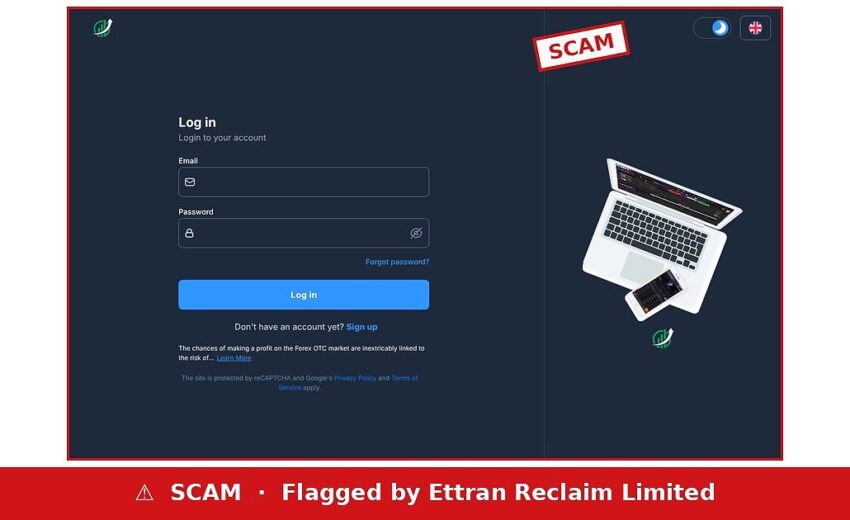
TradeInch ran a client login at my.tradeinch.com for trading on the “Forex OTC market”. New Zealand’s Financial Markets Authority warned about TradeInch on 10 September 2026, as listed on IOSCO’s I-SCAN database. By 17 November 2026 the login no longer loaded, and the domain’s nameservers had been switched to a domain parking service.
RELATED INVESTIGATION 👉
FXCultureTrading Investor Scam Alert
Only a login page
When we first captured it, the public face of TradeInch was a sign-in box, a sign-up link and a short risk line. There was no company name, no address, no terms and no licence number. The sign-up page was protected only by reCAPTCHA. Nothing on the site told a client who held their money or where a complaint could be sent.
Platforms built like this rely on someone else to bring in clients: a cold caller, a “mentor” on social media or a contact in a messaging app who sends the link and helps open the account. That person usually guides every deposit.
What has changed since
The main domain tradeinch.com was registered on 17 November 2025 for one year. Its registration record changed on 17 November 2026, its expiry date, and its nameservers now point to a parking service. In plain terms, the domain was not renewed and the site is gone. Any balance still showing in a client’s account went with it.
This is a common end for login-only platforms. They run for months, collect deposits, and then disappear when complaints and warnings build up. The same operators often reappear under a new name with the same layout.
ALSO SEE THIS REPORT 👉
Weinvesta Scam — Guaranteed Payouts That Double the Maths
If someone sent you the link
Ask who sent it and how they found you. Check whether that person or firm is licensed to give investment advice in your country. Someone who met you online and then introduces a trading platform is a classic warning sign, however friendly or patient they have been.
Verified evidence
- FMA New Zealand warning, 10 September 2026, via IOSCO I-SCAN
- Forex OTC trading login at my.tradeinch.com
- No company, address or licence published
- Domain tradeinch.com registered 17 November 2025 for one year
- On 17 November 2026: login offline, nameservers moved to a parking service
How to check a warning from the FMA
New Zealand’s Financial Markets Authority publishes warnings about firms and websites that may be scams, and the Financial Service Providers Register shows who is registered to offer financial services. Registration on that register is not the same as being licensed, so check both. If a firm claims a licence from another country, check that regulator’s own register too, and confirm the website address matches. Report the site to the FMA and to your bank.
How these schemes usually play out
Bare login pages are not built to attract visitors. Victims are brought in by someone they met online or by a cold caller, who sends the link, helps open the account and often asks for remote access “to help”. A first deposit is followed by a dashboard showing quick profits. When the victim tries to withdraw, a tax, fee or “verification deposit” is demanded. Paying it releases nothing, and the contact eventually disappears.
If you already paid
- Call your bank today, tell them you have paid a fraudulent investment site and ask them to try to recall the payment.
- If you paid by card, ask about a chargeback.
- Change any passwords you shared and remove any remote-access app the caller asked you to install.
- Do not send ID documents or selfies to anyone connected with the site.
- Report the site to the regulator named above and to the police.
- Be wary of anyone who contacts you offering to recover the funds for an upfront fee.
Records to keep
Keep screenshots of the dashboard and your balance, the website address, every email and chat, phone numbers that called you, and every bank, card or crypto payment with dates and amounts. For crypto, keep wallet addresses and transaction hashes. These are the first things your bank, the police and the regulator will ask for.
A trading account with nobody behind it has nobody to answer for your money, and now the site itself has gone. If you deposited with TradeInch, contact Ettran with your records.
Sources: FMA New Zealand alert on TradeInch, 10 September 2026, via IOSCO I-SCAN (iosco.org); RDAP record (registered 17 November 2025, changed 17 November 2026, parking nameservers); my.tradeinch.com captured 14 November 2026, offline 17 November 2026.