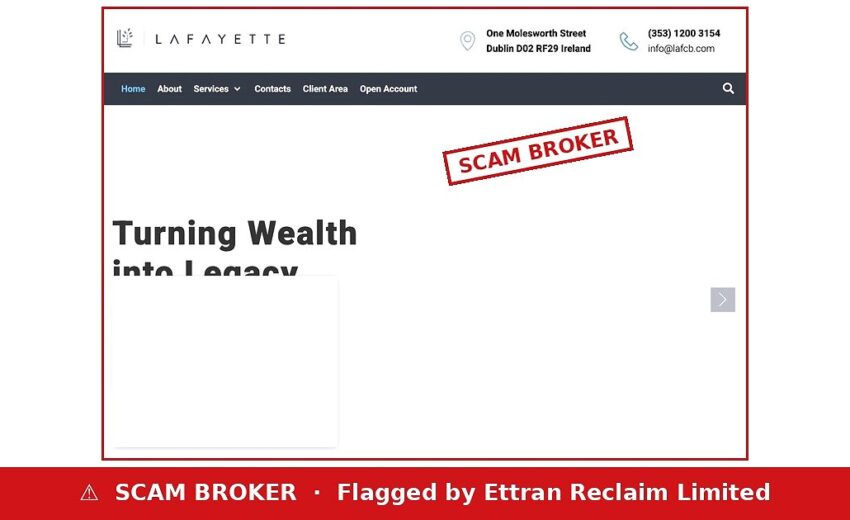
Verdict up front: Lafayette (lafcb.com) sells investment advice, financial planning and off-market private deals from a Dublin address. It shows no authorisation from the Central Bank of Ireland. Australia’s ASIC listed it on 24 September 2026. Do not open an account.
| Website | lafcb.com |
|---|---|
| Claims | Wealth management, Dublin |
| Domain registered | 18 April 2013 (older domain) |
| Regulator | ASIC alert, 24 September 2026 (via IOSCO I-SCAN) |
| Registrar | GoDaddy |
| Status | Live — page loads today |
Regulated services, no regulator
Lafayette offers “Investment Advice”, “Financial Planning”, “Risk Management” and access to “off-market private equity, venture capital, real estate, and direct co-investment opportunities”, with a Client Area and Open Account button. In Ireland these services require Central Bank authorisation. The site does not mention one.
READ THIS BEFORE YOU INVEST 👉
Tenet Option Review: FCA Warning, Regulatory Red Flags, and Why Investors Should Stay Away
A name, not a company
The footer reads only “© 2026 Lafayette”. There is no Limited, no DAC, no company number and no register link.
Did Lafayette call or message you?
✎ FILE A COMPLAINT ABOUT LAFAYETTE
Or write to support@ettran.com — include the website, what you paid and any screenshots. Keep logins and wallet phrases private.
RELATED INVESTIGATION 👉
Weinvesta Scam — Guaranteed Payouts That Double the Maths
Irish address, Australian alert
The header gives One Molesworth Street, Dublin D02 RF29 and a phone written as “(353) 1200 3154”. The alert came from Australia’s ASIC — meaning Australians were being targeted by a firm presenting itself as Irish.
An old domain is not an old firm
lafcb.com was first registered in 2013. Older domains are bought and reused because they look established. What matters is whether the firm behind it is authorised — and here none is named.
⚠ Verified evidence
- ASIC listed Lafayette (lafcb.com) on 24 September 2026 (IOSCO I-SCAN).
- Offers investment advice and private-market deals with no Central Bank of Ireland authorisation shown.
- No company name suffix or number — only “© 2026 Lafayette”.
- Irish address; Australian regulator alert.
Checking Lafayette yourself
Go to ASIC’s Professional Register on Moneysmart, which lists AFS licence holders. Enter lafcb.com first, then the trading name “Lafayette”. An Australian licence has a six-digit AFSL number you can search in seconds. A WHOIS or RDAP lookup on lafcb.com shows the registration date: 18 April 2013 (older domain). No result, or a result with a different website, means no licence for this site.
The verdict: Lafayette offers regulated services with no authorisation and no company behind it, and ASIC has flagged it. Do not open an account.
Share what Lafayette told you
✎ FILE A COMPLAINT ABOUT LAFAYETTE
Or write to support@ettran.com — include the website, what you paid and any screenshots. Your login details stay with you.
Sources, checked 29 September 2026: ASIC via IOSCO I-SCAN (24 September 2026) · RDAP registration record · lafcb.com homepage
Rechecked on 17 November 2026
By 17 November 2026 lafcb.com no longer loaded. The domain lafcb.com was registered on 18 April 2013, and its registration record last changed on 22 September 2026.
How to check an ASIC warning yourself
Search the business or website name on ASIC’s professional registers through ASIC Connect, and check Moneysmart’s investor alert list, which includes the sites ASIC has flagged. A real Australian Financial Services licensee can be found by its licence number and legal name, and the contact details on the register should match the website you are on. If they do not, treat the site as a clone. Losses can be reported to ASIC and to Scamwatch, and card or bank payments should be reported to your bank as fraud straight away.
Even with the site gone, a bank can sometimes still help, especially with recent card payments or transfers to accounts in the UK or EU. Report every payment as fraud as soon as possible, give the bank the website address and the dates, and ask specifically about a chargeback or a recall.
When a platform disappears, its dashboard, balances and statements go with it. Anyone who deposited should gather their own records now: bank and card statements, crypto transaction hashes, emails, chat messages and the names and numbers of anyone who called. Those records are what a bank, the police or a regulator will ask for first.
If you already paid
- Stop all further payments, including any “fee”, “tax” or “release charge”.
- Write down every wallet address you sent crypto to and the transaction hash for each transfer.
- If you bought the crypto through an exchange, report the transfers to that exchange’s support and fraud team.
- Report card and bank payments that funded the purchases to your bank as fraud.
- Report the site to the regulator named above and to the police.
- Be wary of anyone who contacts you offering to recover the funds for an upfront fee.