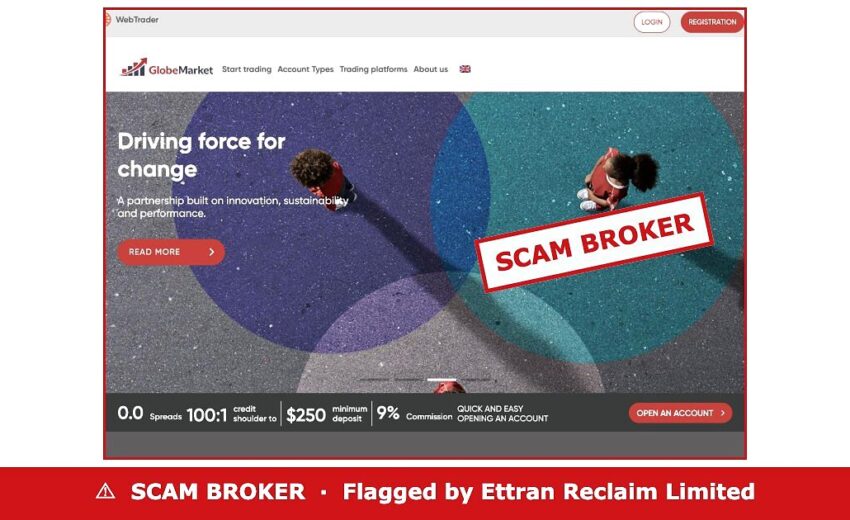
Verdict up front: GlobeMarket (glomark.io), also styled “Globe-Market”, calls itself “a regulated Forex broker”. Its domain was created on 22 September 2026. Australia’s ASIC listed it on 29 September 2026. Do not deposit.
| Website | glomark.io |
|---|---|
| Also called | Globe-Market |
| Domain registered | 22 September 2026 — one week old |
| Regulator | ASIC (Australia) investor alert, 29 September 2026 (via IOSCO I-SCAN) |
| Registry | Identity Digital (.io) record |
| Status | Live — page loads today |
“A leading regulated broker” with no regulator
The homepage says “Start trading with a leading regulated broker”. The footer says “the Authority has granted a securities or derivatives investment business licence to the Licensee”, but never names the authority, the licensee or a licence number. That sentence is lifted boilerplate.
ATTENTION READ THIS 👉
AIXA Miner: CONSOB Warning, Not Authorised
Copyright 2025, domain 2026
The footer says “Copyright © 2025 Globe-Market”. The .io registry record shows the domain was created on 22 September 2026, one week before ASIC listed it.
Got an offer from GlobeMarket?
✎ FILE A COMPLAINT ABOUT GLOBEMARKET
Or write to support@ettran.com — include the website, what you paid and any screenshots. Your login details stay with you.
ALSO SEE THIS REPORT 👉
PrysmTrading Review Serious Warning Signs Investors Shouldn’t Ignore
Bonuses and a $20,000 contest
Visitors are offered a “25% deposit bonus” and the chance to “win up to $20,000USD” in a trading competition. The banner advertises “100:1 credit shoulder”, a $250 minimum deposit and “9% Commission”. Deposit bonuses usually come with turnover rules that lock the deposit in.
Who is excluded
It says it does not serve China, Romania, Singapore or the United States. Australia is not on that list, and ASIC has now warned about it.
⚠ Verified evidence
- ASIC (Australia) listed GlobeMarket (glomark.io) on 29 September 2026 (IOSCO I-SCAN).
- The domain was created on 22 September 2026.
- It calls itself “a regulated Forex broker” but names no regulator or licence.
- It offers a 25% deposit bonus and a $20,000 contest.
Testing GlobeMarket’s claims
The quickest test is ASIC’s Professional Register on Moneysmart, which lists AFS licence holders: search “GlobeMarket” and, separately, glomark.io. A WHOIS or RDAP lookup on glomark.io shows the registration date: 22 September 2026. An Australian licence has a six-digit AFSL number you can search in seconds. If you are outside ASIC’s country, check your own regulator as well.
The verdict: GlobeMarket is a week-old site claiming to be regulated, selling deposit bonuses, and on ASIC’s alert list. Do not deposit.
Share what GlobeMarket told you
✎ FILE A COMPLAINT ABOUT GLOBEMARKET
Or write to support@ettran.com — include the website, what you paid and any screenshots. Keep logins and wallet phrases private.
Sources, checked 29 September 2026: ASIC investor alert via IOSCO I-SCAN (29 September 2026) · RDAP record for glomark.io from the .io registry · the live page at glomark.io, read in full
Rechecked on 17 November 2026
By 17 November 2026 glomark.io no longer loaded.
How to check an ASIC warning yourself
Search the business or website name on ASIC’s professional registers through ASIC Connect, and check Moneysmart’s investor alert list, which includes the sites ASIC has flagged. A real Australian Financial Services licensee can be found by its licence number and legal name, and the contact details on the register should match the website you are on. If they do not, treat the site as a clone. Losses can be reported to ASIC and to Scamwatch, and card or bank payments should be reported to your bank as fraud straight away.
When a platform disappears, its dashboard, balances and statements go with it. Anyone who deposited should gather their own records now: bank and card statements, crypto transaction hashes, emails, chat messages and the names and numbers of anyone who called. Those records are what a bank, the police or a regulator will ask for first.
Former clients of vanished platforms are often contacted again by people claiming the platform has moved, by fake “compliance departments” asking for a release fee, or by “recovery agents” promising to retrieve the money for an upfront payment. These follow-up contacts are usually part of the same scheme. Check anyone who claims to be a lawyer or a regulator independently.
If you already paid
- Stop all further payments, including any “fee”, “tax” or “release charge”.
- Write down every wallet address you sent crypto to and the transaction hash for each transfer.
- If you bought the crypto through an exchange, report the transfers to that exchange’s support and fraud team.
- Report card and bank payments that funded the purchases to your bank as fraud.
- Report the site to the regulator named above and to the police.
- Be wary of anyone who contacts you offering to recover the funds for an upfront fee.