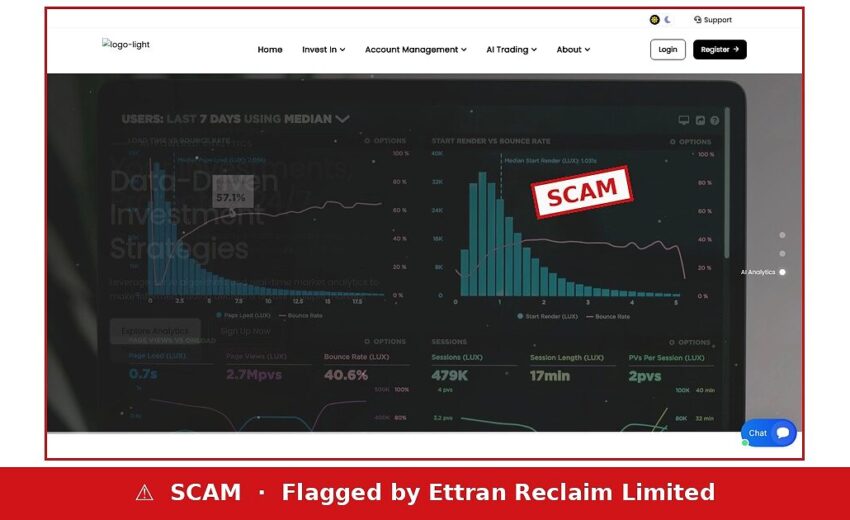
Deep Margins markets deepmargins.com as an “Advanced Forex & Crypto Trading Platform” with investment plans and staking for Bitcoin, Ethereum and USDT. The UK Financial Conduct Authority warned about the firm on 8 May 2026, as recorded on IOSCO’s I-SCAN database. The site was still live in November.
Registered with whom?
The site says it is “Registered with FIU-India and fully compliant by Indian and European standards”. Registration with a financial intelligence unit is an anti money laundering filing, not a licence to manage investments. Deep Margins shows returns “Up to 27%”, “95% Cold Storage” and “$750M+” figures, and a testimonial claims a “32% increase” in three months. The footer still reads “© 2025”.
RELATED INVESTIGATION 👉
XTB Review: Trading Risks, Investor Complaints, and Why Users Should Be Cautious
Verified evidence
- FCA warning on Deep Margins, 8 May 2026, via IOSCO I-SCAN
- Claims “Registered with FIU-India”
- Plans and staking “Up to 27%”
- Large unverified figures: “$750M+”, “$500M”
- Domain registered 19 May 2023
If you staked or invested
Do not pay any fee to release staked coins. Record wallet addresses and transaction hashes, report every payment to your bank and report the site to the FCA and Report Fraud.
IMPORTANT UPDATE 👉
Bakkt.com Review: Institutional Digital Asset Infrastructure
An anti money laundering filing is not an investment licence. If Deep Margins holds your crypto, contact Ettran.
A DEX aggregator and 32% vaults
Deep Margins also advertises a “Cutting-Edge DEX Aggregator” accessing “100+ crypto exchanges”, with “0.01% Lowest Fees”, “$750M+ Daily Volume”, multi-chain support and “MEV protection for large orders”, plus “Yield Optimization Vaults” with a “32% APY Average” and a “4hr Compound Rate”. It claims AI trading with “98.5% Accuracy” and “350+ Expert Traders” to copy.
Each feature borrows a real piece of crypto vocabulary. Together they describe a platform far larger than anything a 2023 domain with a 2025 copyright line and no named company could run. Yields of 27% to 32% a year, presented as normal, are a warning sign on their own.
Copy trading, staking, a DEX aggregator and yield vaults are four different regulated or high-risk activities, all claimed by one unnamed operator.
Quick checks before any deposit
Before sending money to any trading or investment platform, ask three questions. Which company will hold my money, and where is it registered? Which regulator supervises it, and what is the licence number? Does that regulator’s register list this exact website? If any answer is missing, or the register shows a different web address, do not deposit.
A website can be copied, renamed and relaunched in an afternoon. What cannot be faked as easily is a regulator’s register entry. A genuine broker or investment firm names its legal entity, its licence number and its regulator on its website, and the regulator’s site lists the same web address. When those details are missing or do not match, the platform is asking for blind trust.
How to check a warning from the FCA
Search the firm’s exact name and web address on the FCA Financial Services Register and on the FCA warning list. An authorised firm has a firm reference number, and the register shows its approved websites and phone numbers. If the site is not on the register, or its details do not match, you are not dealing with an authorised firm, and you will not be covered by the Financial Ombudsman Service or the FSCS. The FCA’s ScamSmart pages explain the common warning signs. Report the site to the FCA and to Report Fraud.
How these schemes usually play out
Sites like this usually follow the same steps. First comes an advert, a social media message or a phone call. Then a small first deposit, often a few hundred dollars or euros. A dashboard soon shows fast profits, and an “account manager” pushes for a bigger deposit. When you try to withdraw, new fees appear: tax, insurance, verification or “unlocking” charges. Paying them never releases the money. At that stage, stop paying, keep every record, and report what happened.
Keep screenshots of the dashboard and your balance, the website address, every email and chat, phone numbers that called you, and every bank, card or crypto payment with dates and amounts. For crypto, keep the wallet addresses and transaction hashes. These records are what your bank, the police and the regulator will ask for first.
If you already paid
- Stop all further payments, including any “fee”, “tax” or “release charge”.
- Write down every wallet address you sent crypto to and the transaction hash for each transfer.
- If you bought the crypto through an exchange, report the transfers to that exchange’s support and fraud team.
- Report card and bank payments that funded the purchases to your bank as fraud.
- Report the site to the regulator named above and to the police.
- Be wary of anyone who contacts you offering to recover the funds for an upfront fee.
Sources: FCA UK alert on Deep Margins (deepmargins.com), 8 May 2026, via IOSCO I-SCAN (iosco.org); RDAP record (19 May 2023); deepmargins.com captured 17 November 2026.