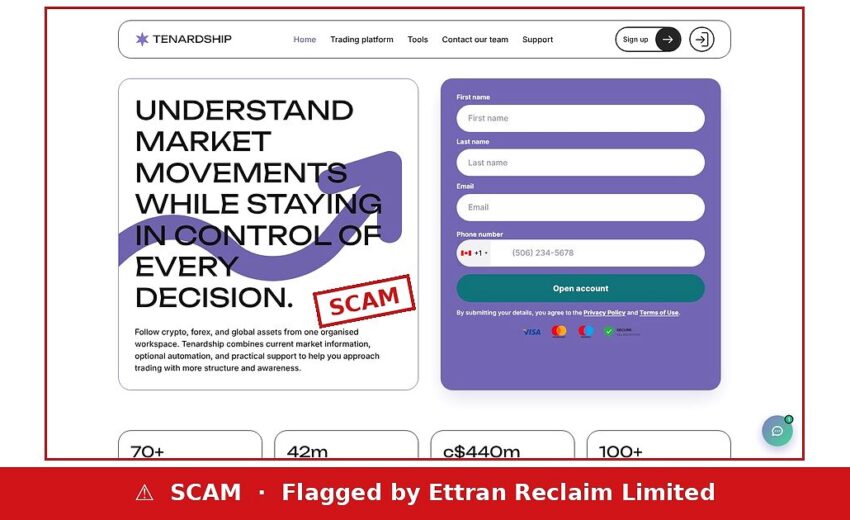
Tenardship calls tenardship.online “the official Tenardship platform” and targets Canadians with AI assisted trading in crypto, forex and global assets. The Alberta Securities Commission warned about it on 16 November 2026, as recorded on IOSCO’s I-SCAN database.
The pitch
A six step guide ends with “the required minimum deposit of C$350”. The site says AI bots “can run continuously” and shows round figures such as “c$440m”. Testimonials praise how easy registration was. No company, registered address or Canadian registration is given, and the footer only says “Rights reserved across Canada”. The domain was registered on 2 October 2026.
ATTENTION READ THIS 👉
ROBINLEDGERMARKETS Review: Unregulated Broker, Fund-Safety Warning
Verified evidence
- Alberta Securities Commission warning, 16 November 2026, via IOSCO I-SCAN
- Minimum deposit C$350
- AI bots that “run continuously”
- No company or registration named
- Domain tenardship.online registered 2 October 2026
Before you deposit
Any firm trading for Canadians must be registered. Check aretheyregistered.ca first. If you already paid, call your bank, save every receipt and report it to the ASC.
ATTENTION READ THIS 👉
The Dark Side of Alliancevalue-partners.com
An “official platform” with no company behind it is not official. If Tenardship holds your money, contact Ettran.
Six steps to a deposit
Tenardship’s guide walks through six steps: provide your information, confirm your email, “open the market workspace” with the C$350 minimum deposit, fund the account by bank transfer, digital wallet or card, set trading preferences, then browse markets. It lists “connected payment and technology providers” without naming any.
The deposit comes at step three, before any trading preferences are set. That order tells you what the process is built to achieve. Testimonials praise how “organised and easy to follow” registration was, which is exactly the part that works.
Tenardship’s footer reads only “© 2026 Tenardship. Rights reserved across Canada.” There is no company name, no registered office and no provincial registration number. Canadian dealers must be registered with a securities regulator and are listed on the national registration search at aretheyregistered.ca, which also shows any disciplinary history. Before paying the C$350 minimum, that search takes under a minute. Statistics on the page, such as “c$440m” and “42m”, match those on Verger Rendoire, a French-language site that Belgium’s FSMA has listed, a sign of a shared template.
Quick checks before any deposit
Before sending money to any trading or investment platform, ask three questions. Which company will hold my money, and where is it registered? Which regulator supervises it, and what is the licence number? Does that regulator’s register list this exact website? If any answer is missing, or the register shows a different web address, do not deposit.
A website can be copied, renamed and relaunched in an afternoon. What cannot be faked as easily is a regulator’s register entry. A genuine broker or investment firm names its legal entity, its licence number and its regulator on its website, and the regulator’s site lists the same web address. When those details are missing or do not match, the platform is asking for blind trust.
How to check a warning from the ASC
Anyone trading or advising in Canada must be registered with a provincial securities regulator. Search the name on the Canadian Securities Administrators’ National Registration Search at aretheyregistered.ca. If the firm is not there, it is not registered. The Alberta Securities Commission and the other provincial regulators publish investor alerts on firms like this one. Report the site to the ASC or your provincial regulator, and report payments to your bank.
How these schemes usually play out
Sites like this usually follow the same steps. First comes an advert, a social media message or a phone call. Then a small first deposit, often a few hundred dollars or euros. A dashboard soon shows fast profits, and an “account manager” pushes for a bigger deposit. When you try to withdraw, new fees appear: tax, insurance, verification or “unlocking” charges. Paying them never releases the money. At that stage, stop paying, keep every record, and report what happened.
Keep screenshots of the dashboard and your balance, the website address, every email and chat, phone numbers that called you, and every bank, card or crypto payment with dates and amounts. For crypto, keep the wallet addresses and transaction hashes. These records are what your bank, the police and the regulator will ask for first.
If you already paid
- Stop all further payments, including any “fee”, “tax” or “release charge”.
- Write down every wallet address you sent crypto to and the transaction hash for each transfer.
- If you bought the crypto through an exchange, report the transfers to that exchange’s support and fraud team.
- Report card and bank payments that funded the purchases to your bank as fraud.
- Report the site to the regulator named above and to the police.
- Be wary of anyone who contacts you offering to recover the funds for an upfront fee.
Sources: Alberta Securities Commission alert on Tenardship, 16 November 2026, via IOSCO I-SCAN (iosco.org); RDAP record (2 October 2026); tenardship.online captured 17 November 2026.