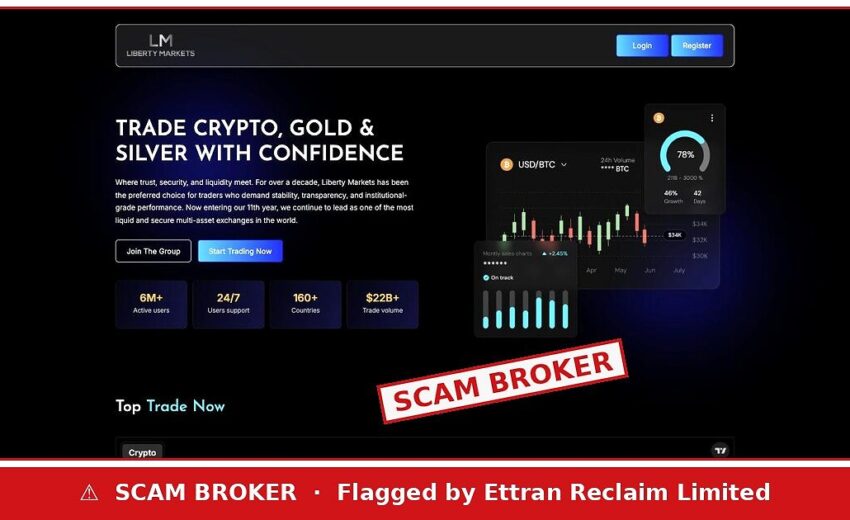
Verdict up front: Liberty Markets (libertymarkets.net) invites you to “trade crypto, gold and silver with confidence” and says it is “now entering our 11th year”. ASIC warned about it on 20 February 2026. The domain was registered on 5 February 2026 — fifteen days before the warning, and about eight months ago.
| Website | libertymarkets.net |
|---|---|
| Products | Crypto, gold and silver trading; copy trading |
| Claims | 11th year; 6M+ users; 160+ countries; $22B+ volume |
| Safety claims | Insured wallets; 100% audited reserves; “regulatory-grade compliance” |
| Warning | ASIC (Australia), 20 February 2026 |
| Domain registered | 5 February 2026 — about 8 months old |
Eleven years in fifteen days
“For over a decade, Liberty Markets has been the preferred choice for traders.” The domain was created in February 2026, and ASIC published its warning fifteen days later. Whatever happened in the previous ten years left no trace on this address.
SCAM ALERT – DON’T MISS THIS 👉
OTM Review: Regulation Concerns, Unregulated Broker
Dealing with Liberty Markets right now?
✎ FILE A COMPLAINT ABOUT LIBERTY MARKETS
Or write to support@ettran.com — Tell us the website, how much you sent and how — screenshots help. We will never ask for passwords or seed phrases.
Insurance and audits nobody signed
The page lists “100% audited reserves”, “insured user wallets” and “institutional-grade insurance”. It names no auditor, no insurer and no regulator. “Regulatory-grade compliance” is a phrase, not a licence.
IMPORTANT UPDATE 👉
Arbiquant Scam — 975 Euro a Day From an 11-Day-Old Site
Copy trading for ‘real profitability’
Copy trading is offered as a route to “real profitability”. On unlicensed platforms the traders you copy and their results live only in the operator’s database.
A bonus that expires this month
“Limited-Time Deposit Bonuses … available for this month only.” Deposit bonuses usually come with turnover conditions that block withdrawals until they are met.
⚠ Verified evidence
- ASIC warning, 20 February 2026.
- Claims its 11th year; domain registered February 2026.
- “Insured wallets” and “audited reserves” with no auditor or insurer.
- Time-limited deposit bonuses.
Paid Liberty Markets — your next steps
- A withdrawal “fee” from Liberty Markets is the next stage of the scam, not a step towards your money.
- Tell family members who may also have been approached about Liberty Markets.
- Card payment? Request a chargeback for “services not provided” as soon as possible.
- Save the trail: payment receipts, wallet addresses, the Liberty Markets dashboard screenshots and every chat.
- Do not reply to new messages from Liberty Markets staff; block the numbers.
How to verify Liberty Markets in two minutes
Search ASIC’s Professional Register on Moneysmart, which lists AFS licence holders for both “Liberty Markets” and libertymarkets.net — a licensed firm turns up under each. Check whether the address on the site matches a real office in a map search. Check how old the address is too — libertymarkets.net dates from 5 February 2026. An Australian licence has a six-digit AFSL number you can search in seconds.
The verdict: Liberty Markets invents a decade of history and a safety net nobody provides. ASIC has warned about it. Do not deposit.
Had money taken by Liberty Markets?
✎ FILE A COMPLAINT ABOUT LIBERTY MARKETS
Or write to support@ettran.com — Include what you paid Liberty Markets and through which bank or wallet. We never need your login details.
Sources, checked 2 October 2026: ASIC (Australia) warning via IOSCO I-SCAN (20 February 2026) · RDAP registration record for libertymarkets.net · the live page at libertymarkets.net, read in full. Listing by a regulator is a warning, not a judgment. Educational only; not personal financial advice.
Rechecked on 17 November 2026
On 17 November 2026 libertymarkets.net was still online, under the page title “Liberty Markets”. The domain libertymarkets.net was registered on 5 February 2026.
How to check an ASIC warning yourself
Search the business or website name on ASIC’s professional registers through ASIC Connect, and check Moneysmart’s investor alert list, which includes the sites ASIC has flagged. A real Australian Financial Services licensee can be found by its licence number and legal name, and the contact details on the register should match the website you are on. If they do not, treat the site as a clone. Losses can be reported to ASIC and to Scamwatch, and card or bank payments should be reported to your bank as fraud straight away.
If you already paid
- Stop all further payments, including any “fee”, “tax” or “release charge”.
- Write down every wallet address you sent crypto to and the transaction hash for each transfer.
- If you bought the crypto through an exchange, report the transfers to that exchange’s support and fraud team.
- Report card and bank payments that funded the purchases to your bank as fraud.
- Report the site to the regulator named above and to the police.
- Be wary of anyone who contacts you offering to recover the funds for an upfront fee.