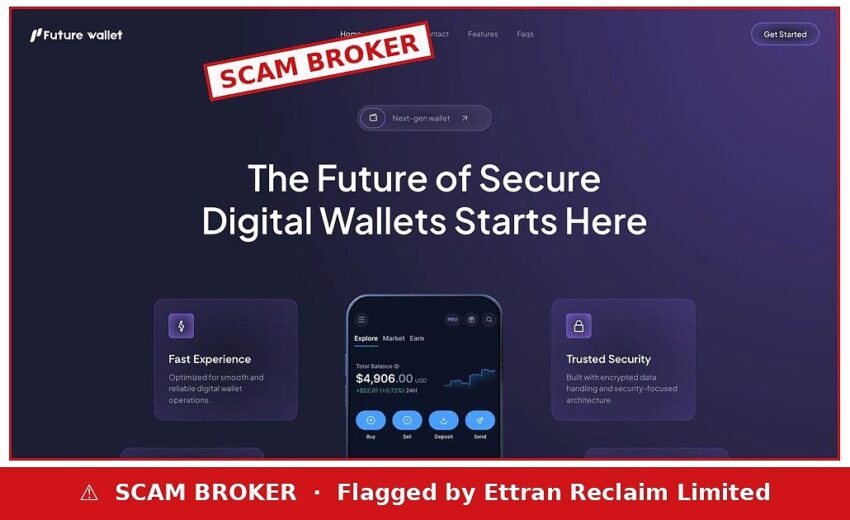
Verdict up front: Future Wallet (future-wallet.io) describes itself as “a secure exchange wallet” for storage, quick exchanges and withdrawals. Australia’s ASIC flagged future-wallet.io on 28 August 2026. Today that address forwards to future-wallet.net, a domain registered on 29 July 2026. The .io dates from 20 January 2026.
| Website | future-wallet.io → future-wallet.net |
|---|---|
| Product | “Exchange wallet”: storage, swaps, withdrawals, portfolio |
| Company named | None — “© 2026 Future wallet” |
| Support | Support ticket and online chat only |
| Regulator | ASIC (Australia), 28 August 2026 |
| Domains registered | .io 20 January 2026 · .net 29 July 2026 |
Moved before the warning landed
The flagged address now sends visitors to a .net domain created a month before ASIC’s alert. Keeping the brand while changing the domain is how these sites outlive warnings — a search for the new address finds nothing.
SCAM ALERT – DON’T MISS THIS 👉
Nexymus Alert: Serious Trading Platform Risks
Approached by Future Wallet?
✎ FILE A COMPLAINT ABOUT FUTURE WALLET
Or write to support@ettran.com — Attach receipts or screenshots if you have them. Keep your passwords and recovery words to yourself.
A wallet that holds your coins
“Access your digital assets, manage exchanges, and track your portfolio,” the homepage says. An ‘exchange wallet’ means the operator holds the keys. In Australia, digital currency exchanges must register with AUSTRAC. The site names no company and no registration.
SCAM ALERT – DON’T MISS THIS 👉
ELITE TRADEPRO Review: Regulation Concerns, Fund-Safety Warning
Disclaimers in place of details
The footer says Future wallet “is an exchange wallet platform”, that availability “may vary by region”, and that it “does not provide financial or investment advice”. It does not say who runs it or where.
How people end up here
Custodial ‘wallets’ with no company are often the deposit stage of investment scams: a contact sends the link, the balance grows on screen, and withdrawals need a fee first.
⚠ Verified evidence
- ASIC flagged future-wallet.io on 28 August 2026.
- The .io now redirects to future-wallet.net, registered 29 July 2026.
- Custodial ‘exchange wallet’ with no company named.
- Contact by support ticket only.
What to do after paying Future Wallet
Do not pay any “tax”, “unlock” or “verification” fee Future Wallet asks for — those charges never release a balance. If Future Wallet had you install screen-sharing software, delete it and run a security scan. Reset your email and banking passwords if Future Wallet ever saw your screen.
- Ask your bank’s fraud team to recall the payment to Future Wallet and to flag the receiving account.
Testing Future Wallet’s claims
The quickest test is ASIC’s Professional Register on Moneysmart, which lists AFS licence holders: search “Future Wallet” and, separately, future-wallet.io future-wallet.net. Look up the domain’s registration date — new domains and long histories do not mix. An Australian licence has a six-digit AFSL number you can search in seconds. Search the name with the words “warning” and “reviews” too — victims often post first.
The verdict: Future Wallet asks you to hand over your crypto to a nameless operator that has already changed domains once, and ASIC has flagged it. Do not deposit.
Share what Future Wallet told you
✎ FILE A COMPLAINT ABOUT FUTURE WALLET
Or write to support@ettran.com — Tell us the website, how much you sent and how — screenshots help. We will never ask for passwords or seed phrases.
Sources, checked 1 October 2026: ASIC (Australia) warning via IOSCO I-SCAN (28 August 2026) · RDAP registration record for future-wallet.io · the live page at future-wallet.io, read in full · RDAP record for future-wallet.net. Warnings come from regulators, not courts. General information, not investment advice.
Rechecked on 17 November 2026
By 17 November 2026 future-wallet.io no longer loaded.
How to check an ASIC warning yourself
Search the business or website name on ASIC’s professional registers through ASIC Connect, and check Moneysmart’s investor alert list, which includes the sites ASIC has flagged. A real Australian Financial Services licensee can be found by its licence number and legal name, and the contact details on the register should match the website you are on. If they do not, treat the site as a clone. Losses can be reported to ASIC and to Scamwatch, and card or bank payments should be reported to your bank as fraud straight away.
If you already paid
- Stop all further payments, including any “fee”, “tax” or “release charge”.
- Write down every wallet address you sent crypto to and the transaction hash for each transfer.
- If you bought the crypto through an exchange, report the transfers to that exchange’s support and fraud team.
- Report card and bank payments that funded the purchases to your bank as fraud.
- Report the site to the regulator named above and to the police.
- Be wary of anyone who contacts you offering to recover the funds for an upfront fee.