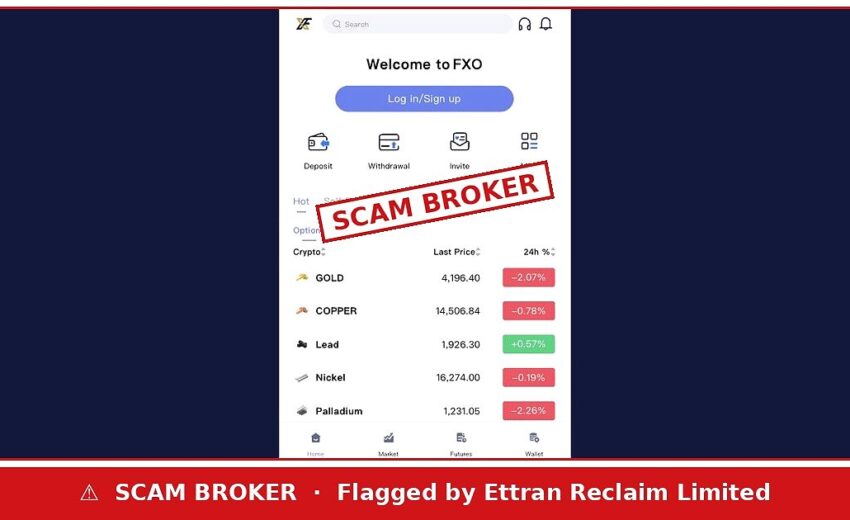
Verdict up front: fxoxx.net greets visitors with “Welcome to FXO” and a phone-style trading app with Deposit, Withdrawal and Invite buttons — and no company name anywhere. Greece’s Hellenic Capital Market Commission put the site on its warning list on 24 September 2026. It has no connection to any licensed broker with a similar name. Do not deposit.
| Website | fxoxx.net |
|---|---|
| Name used | FXO |
| Domain registered | 5 May 2026 — under five months old |
| Regulator warning | Hellenic Capital Market Commission (Greece), 24 September 2026, via IOSCO I-SCAN |
| Registrar | Dynadot Inc |
| Status | Live today |
An app, not a company
Open fxoxx.net on a desktop and you get a narrow mobile layout: a search bar, “Log in/Sign up”, four icons (Deposit, Withdrawal, Invite, More) and tabs for Hot, Self Service and Options. The bottom bar reads Home, Market, Futures, Wallet. There is no footer, no terms link, no company name, no address and no regulator.
RELATED INVESTIGATION 👉
Orbisolyx — A Menu That Says Home Twice
Approached by fxoxx.net?
✎ FILE A COMPLAINT ABOUT FXOXX.NET
Or write to support@ettran.com — include the website, what you paid and any screenshots. Your login details stay with you.
Options on metals, under a “Crypto” heading
The Options list shows gold, copper, lead, nickel, palladium, silver, zinc, aluminium and platinum — under a column headed “Crypto”. Short-duration “options” on price moves are the format regulators most often find in fake trading apps: the balance on screen is a number the operator controls.
ATTENTION READ THIS 👉
Saham Profit Review: Unregulated Broker, Regulation Concerns
The Invite button
An “Invite” icon on the home screen is a referral scheme. Platforms that pay you to recruit friends and family grow fastest just before they stop paying withdrawals.
⚠ Verified evidence
- Hellenic Capital Market Commission (Greece) listed fxoxx.net on 24 September 2026 (IOSCO I-SCAN).
- The site names no company, address, licence or regulator.
- Home screen has Deposit, Withdrawal and Invite buttons.
- Sells short-term options on metals.
- fxoxx.net was registered on 5 May 2026.
Testing fxoxx.net’s claims
Search the licence search of your home regulator, then I-SCAN for both “fxoxx.net” and fxoxx.net — a licensed firm turns up under each. IOSCO’s I-SCAN gathers warnings from many regulators in a single search box. Check how old the address is too — fxoxx.net dates from 5 May 2026. A company number is not a licence — only a financial regulator can grant one.
The verdict: fxoxx.net is an anonymous deposit-and-invite options app less than five months old, and Greece’s regulator has warned about it. Do not deposit.
Share what fxoxx.net. told you
✎ FILE A COMPLAINT ABOUT FXOXX.NET
Or write to support@ettran.com — include the website, what you paid and any screenshots. Keep logins and wallet phrases private.
Sources, checked 28 September 2026: IOSCO I-SCAN entry “https://fxoxx.net/” — Greece, Hellenic Capital Market Commission, 24 September 2026 · RDAP registration record for fxoxx.net · the live app at fxoxx.net, read in full
Rechecked on 17 November 2026
By 17 November 2026 fxoxx.net no longer loaded. The domain fxoxx.net was registered on 5 May 2026, and its registration record last changed on 17 November 2026.
How to check a regulator warning yourself
Before depositing, search the firm’s exact name and web address on your national regulator’s register and warning list, such as the FCA in the UK, ASIC in Australia or the SEC and FINRA in the US. A real firm names its legal entity, address and licence number, and those details match the regulator’s record. If any of that is missing, do not send money. Report losses to your bank and to the police or national fraud reporting service.
Even with the site gone, a bank can sometimes still help, especially with recent card payments or transfers to accounts in the UK or EU. Report every payment as fraud as soon as possible, give the bank the website address and the dates, and ask specifically about a chargeback or a recall.
When a platform disappears, its dashboard, balances and statements go with it. Anyone who deposited should gather their own records now: bank and card statements, crypto transaction hashes, emails, chat messages and the names and numbers of anyone who called. Those records are what a bank, the police or a regulator will ask for first.
If you already paid
- Stop all further payments, including any “fee”, “tax” or “release charge”.
- Write down every wallet address you sent crypto to and the transaction hash for each transfer.
- If you bought the crypto through an exchange, report the transfers to that exchange’s support and fraud team.
- Report card and bank payments that funded the purchases to your bank as fraud.
- Report the site to the regulator named above and to the police.
- Be wary of anyone who contacts you offering to recover the funds for an upfront fee.