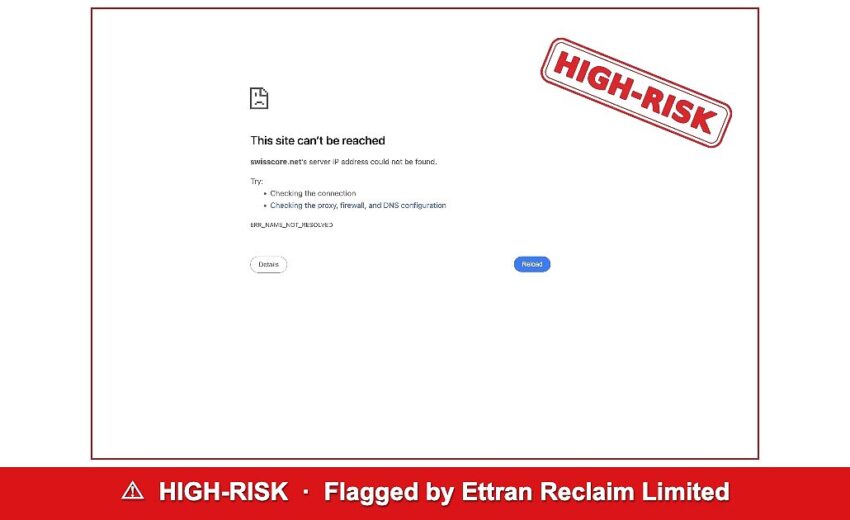
Verdict up front: Swiss Core (swisscore.net) was placed on FINMA’s warning list on 6 August 2026, and its domain has since been suspended by the registrar — the site no longer loads. FINMA confirms it is not entered in the Swiss commercial register. Treat any “Swiss Core” contact as a scam approach.
Verified evidence (checked 27 August 2026)
- Regulator warning: FINMA, the Swiss Financial Market Supervisory Authority, added SwissCore / swisscore.net to its public warning list on 6 August 2026, giving an address at Heinrichstrasse 267n, 8005 Zürich.
- Not a Swiss company: FINMA’s entry records the entity as “not entered in commercial register”. Despite the Swiss branding and the Zürich address, no such company exists on the Swiss register.
- Site status: the domain is on registrar clientHold and no longer resolves — the site will not load. The status was applied on 24 August 2026, eighteen days after the FINMA listing.
- Domain age: registered 21 April 2026 (registrar NameCheap) — about three and a half months of life before FINMA listed it, and roughly four before it went dark.
- Consumer legal alert: a German law firm published a public warning about swisscore.net on suspicion of Anlagebetrug (investment fraud).
- No Swiss authorisation: no FINMA licence was found for the operation. Sources: FINMA warning list (6 Aug 2026); registry RDAP; German consumer legal alert.
| Related Investigation Why “Swiss” branding is a favourite of investment fraud. |
Investors, Take Note A suspended domain usually means the scam has finished its run. |
Read This Before You Invest “Swiss” in a name is not FINMA authorisation. |
What was Swiss Core?
Swiss Core traded on the reputation of Swiss finance. It ran as an online platform offering forex, crypto, stocks and indices with artificial-intelligence assistance, gave a Zürich street address, and used a name engineered to evoke two centuries of Swiss banking conservatism. It held no Swiss authorisation, and FINMA has confirmed that no company by that name is entered in the Swiss commercial register at all.
WARNING: MUST READ 👉
spotfxoptions Review: Unregulated Broker, Regulation Concerns
The arc is now complete: registered in April 2026, listed by the national regulator in August, and suspended at the registrar weeks later. What remains is the aftermath — the people who deposited while it was live.
What FINMA’s warning list is
FINMA supervises banks, insurers, securities firms and financial-market infrastructure in Switzerland. Alongside its register of authorised institutions it maintains a public warning list of companies that may be conducting financial-market activity without the authorisation such activity requires.
Two details in the Swiss Core entry carry particular weight. The first is the commercial-register finding: in Switzerland, a company conducting commercial activity is required to be entered on the cantonal commercial register, a public record searchable by anyone. FINMA states plainly that Swiss Core is not on it. The Zürich address on the website therefore corresponds to no registered Swiss undertaking. The second is that the entry names the domain itself, tying the warning to swisscore.net rather than to a company name that could simply be changed.
What “clientHold” means
A domain shown as clientHold has been removed from the DNS zone by its registrar. The name still exists in the registry, but it resolves to nothing: browsers cannot reach it, email to the domain bounces, and any customer portal hosted on it is gone. Registrars apply this status in response to abuse complaints, court or law-enforcement requests, or their own investigation.
INVESTORS, TAKE NOTE 👉
Go Future ProMarket Review: Unregulated Broker, Fund-Safety Warning
Read in sequence, the dates tell the story. Registered 21 April. Warned by FINMA on 6 August. Suspended on 24 August. That is a four-month operating life, which is entirely ordinary for this kind of platform — long enough to run a marketing campaign and collect deposits, short enough to be gone before most victims have finished escalating.
Why “Swiss” is such a common prop
Switzerland’s financial reputation is a marketing asset available to anyone willing to register a domain, because the words “Swiss”, “Zürich” and “Geneva” are not themselves protected credentials. A Swiss address costs a mail-forwarding fee. The connotation — discretion, stability, careful stewardship of other people’s money — comes free.
The same logic drives the misuse of “AG”, “GmbH” and “Capital” in platform names, and of London, Frankfurt and New York addresses elsewhere. None of these is a licence. The only thing that functions as a licence is an entry on a regulator’s register, under a firm reference number you can look up yourself, at a domain the register itself publishes.
Check it for yourself
Nothing above depends on trusting us. Search the name on Google, ask ChatGPT, and run the register checks named in the evidence box. A regulator warning takes about a minute to confirm on the regulator’s own website, and that minute is the cheapest due diligence available to any investor.
Search FINMA’s warning list for swisscore, and search the Swiss commercial register (Zefix) for a company at the Heinrichstrasse address. The first returns a listing; the second returns nothing, which is exactly what FINMA recorded. Trying swisscore.net now produces no page at all — a result that is itself informative.
If you have already deposited
Act on paper, not on hope. Save every screenshot, chat log, email, payment reference and wallet address before the platform can close your account — once access goes, so does your evidence. Report the loss to your national financial regulator and to your police force’s fraud unit. Tell your bank or card issuer immediately; where funds moved by card or transfer within recent weeks, a recall or chargeback is sometimes still possible. If you paid in cryptocurrency, the transaction cannot be reversed, but the receiving address is permanent evidence and exchanges can sometimes freeze onward movement.
Then brace for the second approach. Victims of investment fraud are frequently contacted again by people offering to recover the money for an upfront fee, sometimes posing as lawyers, regulators or the platform’s own compliance department. That is a second fraud aimed at the same victim. No legitimate recovery service, and no regulator anywhere, asks for a payment before returning your funds.
The bottom line
Swiss Core borrowed a country’s financial reputation, ran for four months, drew a national regulator’s warning and a German fraud alert, and has been switched off at the registrar. If it approaches you again under a new name — and operations like this generally do — the new site will be equally young and equally unlicensed.
Reviewed by David Sanders, Licensed Fraud Investigation Agent, Investor Protection Unit — Pinkerton. Corrections: support@ettran.com.