
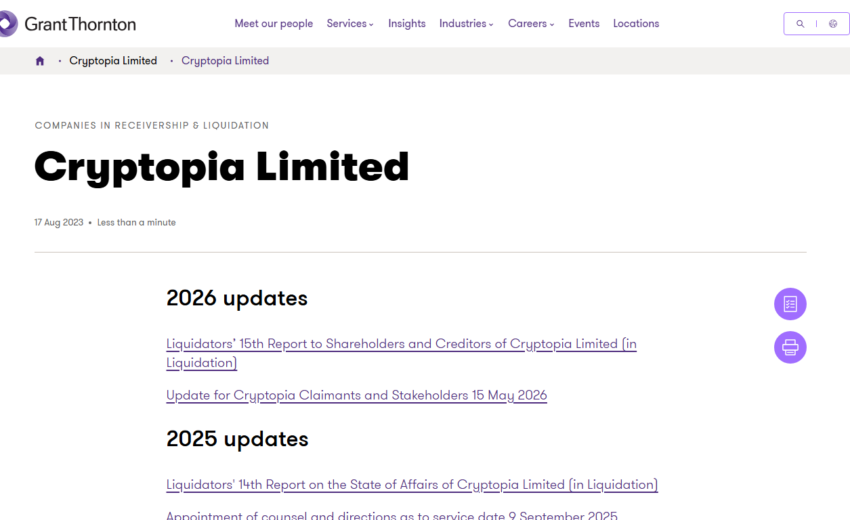
Cryptopia of Liquidation Introduction
The page from Grant Thornton New Zealand tracks the ongoing liquidation of Cryptopia, a once-popular cryptocurrency exchange that collapsed after a major security breach and operational failure. Unlike a typical “company update,” this page is part of a court-supervised insolvency process, meaning it documents legal, financial, and recovery actions rather than normal business activity.
Cryptopia is widely regarded as one of the most significant early crypto exchange failures, and its liquidation process has become a landmark case in crypto law and asset recovery.
READ THIS BEFORE YOU INVEST 👉
goldentradelimited.com Review: Unregulated Broker, Fund-Safety Warning
REPORT A SCAM FAST!
What Cryptopia Was
Cryptopia was a New Zealand-based cryptocurrency exchange that:

- Allowed trading of hundreds of crypto assets
- Served millions of users globally
- Became one of the larger retail altcoin exchanges in its early years
However, the platform suffered a major security incident in January 2019, where significant crypto assets were stolen. This event triggered a chain reaction that ultimately led to liquidation.
Key Events Leading to Liquidation
Based on official liquidation records:
- January 2019: Major hack results in significant crypto losses
- May 2019: Cryptopia enters liquidation under Grant Thornton NZ
- Trading activity is halted and controlled by liquidators
- Court proceedings begin to determine ownership of user assets
A key legal question became whether customer crypto assets were:

ALSO SEE THIS REPORT 👉
Whale Market Inc Review: Unregulated Broker, Regulation Concerns
- Owned by the company, or
- Held in trust for users
The High Court of New Zealand later ruled that user cryptocurrencies were held in trust, meaning account holders had legal ownership rights over their assets rather than being unsecured creditors.
What the Grant Thornton Updates Show
The updates on the page reflect a long-running liquidation process involving:

1. Asset Recovery and Wallet Reconstruction
Liquidators have been:
- Rebuilding wallet infrastructure
- Tracking blockchain transactions
- Recovering and securing remaining crypto assets
- Working with cybersecurity experts
This is not a simple accounting exercise—it involves forensic blockchain reconstruction due to missing or incomplete records.
REPORT A SCAM FAST!
2. Claims and Verification Process
A major part of the process is:
- Identifying legitimate account holders
- Verifying identity (KYC/AML checks)
- Matching exchange records with blockchain data
- Allowing users to register claims through a portal
This process has taken years due to incomplete records and large user volume.
3. Legal Complexity and Court Supervision
The liquidation has required:
- Multiple High Court hearings
- International legal actions
- Court directions on distribution methods
One key reason for delay is that crypto assets are legally complex and require:
- Determining ownership structure
- Handling missing or disputed balances
- Ensuring compliance with financial regulations
4. Ongoing Distribution Efforts
Recent updates indicate:
- Partial or interim distributions have begun or are planned
- Some users may receive staged repayments
- Full distribution depends on asset recovery and verification completion
REPORT A SCAM FAST!
Why This Case Is Important
Cryptopia is considered a landmark crypto insolvency case because it established:
- Crypto assets can be treated as legal property
- Exchanges may hold user funds in trust relationships
- Users may have stronger rights than typical unsecured creditors
This has influenced how future crypto exchanges and courts handle insolvency cases.
Risks Highlighted by the Cryptopia Case
Even though this page is not about fraud, it highlights major structural risks in crypto platforms:
1. Exchange Custody Risk
If users leave funds on exchanges:
- They do not fully control private keys
- Funds can become locked during insolvency
- Access may take years to restore
2. Security Risk
Cryptopia’s collapse began with:
- A successful hack
- Loss of customer funds
- Weak wallet and security infrastructure at the time
REPORT A SCAM FAST!
3. Legal Recovery Delays
Even when funds are recoverable:
- Legal processes can take years
- Courts must determine ownership structures
- Distribution is complex and phased
User Sentiment (General Context)
Across public discussions (forums and crypto communities), Cryptopia is often referenced as:
- A cautionary example of “not your keys, not your coins”
- A case showing how exchange failures can take years to resolve
- A reminder of custodial risk in centralized platforms
Conclusion
The Grant Thornton Cryptopia updates represent an ongoing court-managed liquidation process, not an active business operation. The case demonstrates both the potential recoverability of crypto assets and the severe downsides of leaving funds on centralized exchanges during failures or hacks.
Key takeaway
Cryptopia is not an active trading platform—it is a long-running insolvency and asset recovery case, and its updates should be understood in the context of legal liquidation rather than normal crypto exchange operations.