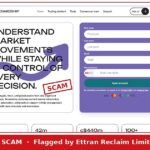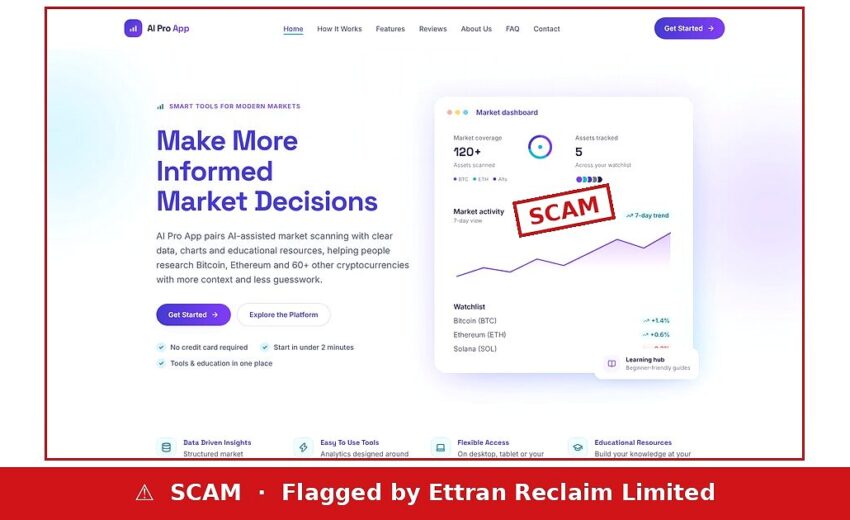
AI Pro App markets ai-proapp.com as an “AI Crypto Research Assistant” for Bitcoin, Ethereum and “60+ other cryptocurrencies”. The Australian Securities and Investments Commission flagged the site on 17 November 2026, an alert recorded on IOSCO’s I-SCAN database.
What the form is for
The page stresses “No credit card required” and “Start in under 2 minutes”. The sign-up form asks only for name, email and phone number, and the phone field came pre-set to +27, the South African code. The footer calls it educational content only. Sites built this way usually pass your number to call centres that then push you to deposit with an unlicensed broker.
ALSO SEE THIS REPORT 👉
Cfd Trades Review: Unregulated Broker, Regulation Concerns
Verified evidence
- ASIC alert on ai-proapp.com, 17 November 2026, via IOSCO I-SCAN
- “No credit card required”, “Start in under 2 minutes”
- Form collects name, email and phone, default code +27
- Claims “120+ assets scanned”
- Domain registered 15 September 2026
If someone called you after signing up
Do not install remote-access apps and do not read out bank codes. If you sent money, call your bank about each payment, keep the caller’s numbers and report it to ASIC or Scamwatch.
WARNING: MUST READ 👉
FOREXIS FINANCIAL INNOVATION MARKETS Review: Unregulated Broker, Regulation Concerns
A free sign-up is often the product being sold: your phone number. If AI Pro App led to a loss, contact Ettran with your records.
What the site says about itself
AI Pro App promises coverage of crypto, forex, stocks and commodities, “60+ markets tracked”, “6+ core tools” and “24/7 access”. A small line underneath reads: “Figures describe the platform itself rather than trading outcomes. Market results vary and are never guaranteed.” That disclaimer is honest. It also means the site makes no promise you could hold it to, while the phone call that follows sign-up usually does.
Pages like this often change their wording when a regulator acts, while the call centre behind them stays the same. The phone number you gave is the thing that matters.
The phone field defaulting to +27, the South African code, suggests where the campaign was being run when we captured it.
Its own FAQ describes it as general information and education only.
Quick checks before any deposit
Before sending money to any trading or investment platform, ask three questions. Which company will hold my money, and where is it registered? Which regulator supervises it, and what is the licence number? Does that regulator’s register list this exact website? If any answer is missing, or the register shows a different web address, do not deposit.
How to check an ASIC warning yourself
Search the business or website name on ASIC’s professional registers through ASIC Connect, and check Moneysmart’s investor alert list, which includes the sites ASIC has flagged. A real Australian Financial Services licensee can be found by its licence number and legal name, and the contact details on the register should match the website you are on. If they do not, treat the site as a clone. Losses can be reported to ASIC and to Scamwatch, and card or bank payments should be reported to your bank as fraud straight away.
How these schemes usually play out
Sites like this usually follow the same steps. First comes an advert, a social media message or a phone call. Then a small first deposit, often a few hundred dollars or euros. A dashboard soon shows fast profits, and an “account manager” pushes for a bigger deposit. When you try to withdraw, new fees appear: tax, insurance, verification or “unlocking” charges. Paying them never releases the money. At that stage, stop paying, keep every record, and report what happened.
Keep screenshots of the dashboard and your balance, the website address, every email and chat, phone numbers that called you, and every bank, card or crypto payment with dates and amounts. For crypto, keep the wallet addresses and transaction hashes. These records are what your bank, the police and the regulator will ask for first.
If you already paid
- Stop all further payments, including any “fee”, “tax” or “release charge”.
- Write down every wallet address you sent crypto to and the transaction hash for each transfer.
- If you bought the crypto through an exchange, report the transfers to that exchange’s support and fraud team.
- Report card and bank payments that funded the purchases to your bank as fraud.
- Report the site to the regulator named above and to the police.
- Be wary of anyone who contacts you offering to recover the funds for an upfront fee.
Sources: ASIC alert on ai-proapp.com, 17 November 2026, via IOSCO I-SCAN (iosco.org); RDAP record (15 September 2026); ai-proapp.com captured 17 November 2026.