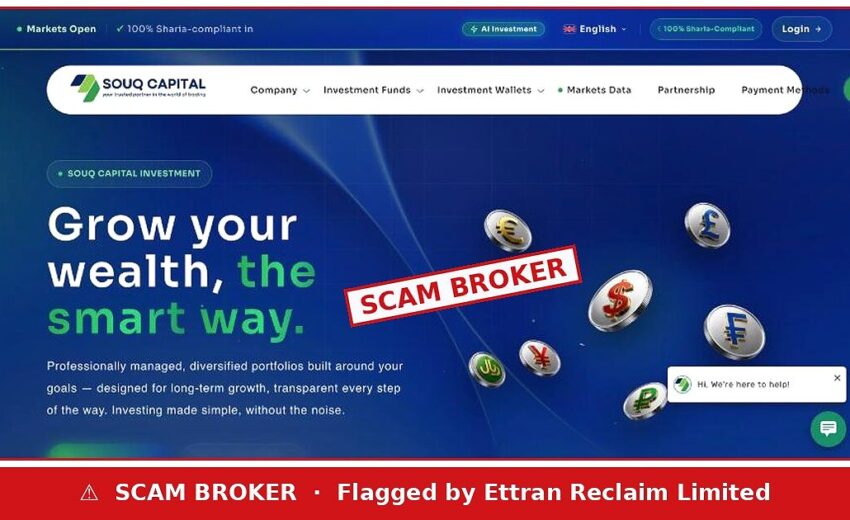
Verdict up front: Souq Capital Investment (souqcapital.com) advertises “100% Sharia-compliant investing”, “Monthly profits to your wallet” and “AI Investment”. It is listed on the BrokersView (FastBull) scam broker list. The domain was registered on 22 January 2015 — about 11 years 8 months ago.
| Website | souqcapital.com |
|---|---|
| Name used | Souq Capital Investment |
| Promise | “Monthly profits to your wallet” |
| Claim | “A licensed & regulated investment platform trusted by 50,000+ investors” |
| Products | Five “halal investment wallets”, AI investment |
| Listed | BrokersView (FastBull) scam broker list |
| Domain registered | 22 January 2015 — about 11 years 8 months old |
Licensed by nobody named
The site says it is “a licensed & regulated investment platform trusted by 50,000+ investors worldwide”. It never says which regulator or which licence. Faith-based branding does not replace that check.
RELATED INVESTIGATION 👉
Marketindex Exchange Review: Regulation Concerns, Unregulated Broker
Approached by Souq Capital?
✎ FILE A COMPLAINT ABOUT SOUQ CAPITAL
Or write to support@ettran.com — Attach receipts or screenshots if you have them. Keep your passwords and recovery words to yourself.
Monthly profits
Paying “monthly profits to your wallet” describes a fixed return, not trading. Real investments go up and down. Steady payouts from an unlicensed firm are a classic sign of money from new deposits paying earlier ones.
ATTENTION READ THIS 👉
Preforea.cc Review: Regulatory Warnings, Fraud Indicators, and Why Investors Should Avoid This High-Risk Trading Platform
Using religion to build trust
“100% Sharia-compliant” and “halal wallets” are aimed at Muslim investors. Fraudsters use shared faith to lower people’s guard — regulators in the Gulf and the UK have warned about exactly this.
An old domain, a new story
The domain dates from 2015, but nothing on the site shows a history: no company number, no audited accounts, no regulator. An old address can be bought.
⚠ Verified evidence
- Listed on the BrokersView (FastBull) scam broker list.
- Promises monthly profits to your wallet.
- Claims to be licensed without naming a regulator.
- Domain registered 22 January 2015.
What to do after paying Souq Capital
- Refuse any extra payment Souq Capital says is needed to release profits.
- Treat any “recovery agent” who contacts you about Souq Capital as a second scam if they want money first.
- Warn friends who joined through the same contact as you did.
- Ask your bank’s fraud team to recall the payment to Souq Capital and to flag the receiving account.
- Report to your national fraud reporting centre as well as the police.
- Do not reply to new messages from Souq Capital staff; block the numbers.
Testing Souq Capital’s claims
Search the licence search of your home regulator, then I-SCAN for both “Souq Capital” and souqcapital.com — a licensed firm turns up under each. No result, or a result with a different website, means no licence for this site. A WHOIS or RDAP lookup on souqcapital.com shows the registration date: 22 January 2015. A company number is not a licence — only a financial regulator can grant one.
The verdict: Souq Capital promises steady monthly profits and names no licence. Do not deposit.
Share what Souq Capital told you
✎ FILE A COMPLAINT ABOUT SOUQ CAPITAL
Or write to support@ettran.com — A short note is enough: when you paid Souq Capital, how, and how much. No passwords, ever.
Sources, checked 5 October 2026: BrokersView (FastBull) scam broker list · RDAP registration record for souqcapital.com · the live page at souqcapital.com, read in full. No court has ruled on this firm; the listing is a warning. Educational only; not personal financial advice.
Rechecked on 17 November 2026
On 17 November 2026 souqcapital.com was still online, under the page title “Investment that fits your goals | Souq Capital”. The domain souqcapital.com was registered on 22 January 2015.
How to check a regulator warning yourself
Before depositing, search the firm’s exact name and web address on your national regulator’s register and warning list, such as the FCA in the UK, ASIC in Australia or the SEC and FINRA in the US. A real firm names its legal entity, address and licence number, and those details match the regulator’s record. If any of that is missing, do not send money. Report losses to your bank and to the police or national fraud reporting service.
If you already paid
- Stop all further payments, including any “fee”, “tax” or “release charge”.
- Write down every wallet address you sent crypto to and the transaction hash for each transfer.
- If you bought the crypto through an exchange, report the transfers to that exchange’s support and fraud team.
- Report card and bank payments that funded the purchases to your bank as fraud.
- Report the site to the regulator named above and to the police.
- Be wary of anyone who contacts you offering to recover the funds for an upfront fee.